

What Is The Makeup Of Amoeba
What is Amoeba?
Amoeba (plural amoebas/amoebae) is a group of primitive protists. Among the big family of Amoebas, Amoeba proteus is probably the best-known member – mutual in classrooms and research laboratories.
Amoeba proteus is known for the way they move, a archaic crawling fashion – through extension and retraction of "false feet" (or pseudopods) over varied substrates. Amoeba proteus does non have a fixed shape – it constantly changes because it extends its pseudopods.
The ability to move by pseudopods is the mutual feature of the Amoeba family, although some of them look quite different from Amoeba proteus.
Is Amoeba a cell?
Yeah, Amoeba is a single-celled organism, significant one Amoeba consists of just 1 giant cell.
Amoeba belongs to the eukaryotic cells, which means that their genetic material (or DNA) are well organized and enclosed within a membrane by forming a "nucleus". In this aspect, Amoeba is closer to our homo beings (are also eukaryotes) than bacteria (prokaryotes).
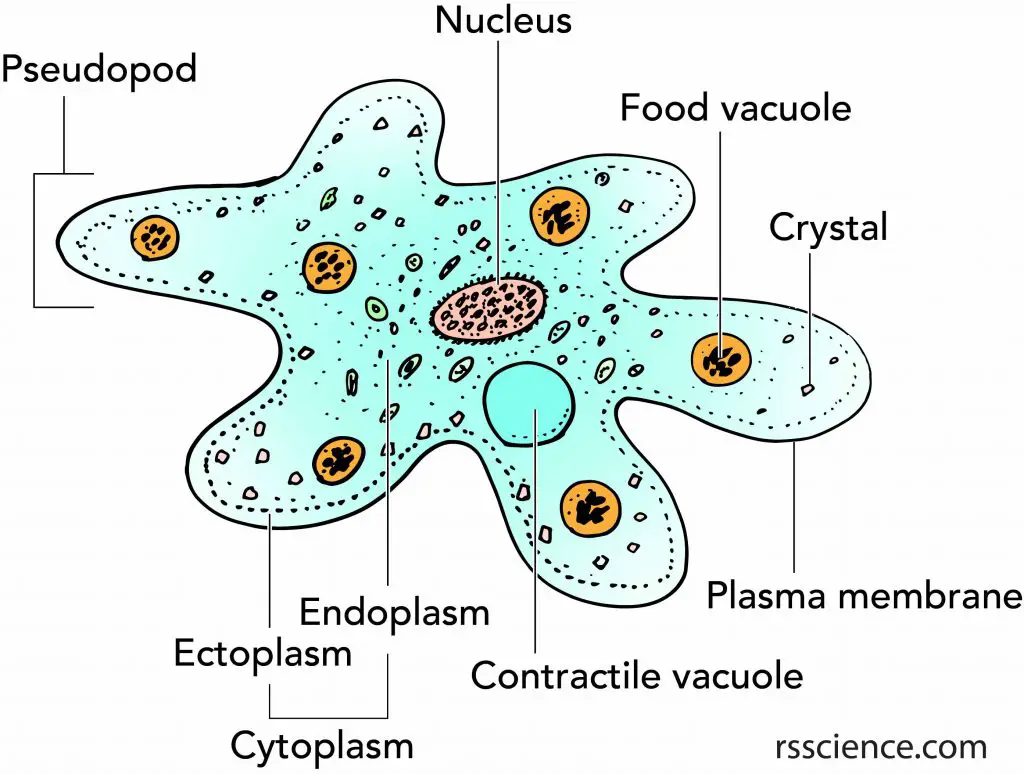
The microanatomy of Amoeba: an amoeba has a single granular nucleus, containing most of the organism'due south DNA.
Amoeba move and chase past extending pseudopods.
A contractile vacuole is used to maintain osmotic equilibrium by excreting excess water from the prison cell.
Several nutrient vacuoles are used to digest food particles.
The cytoplasm tin be divided into ii parts: a granular inner endoplasm and an outer layer of articulate ectoplasm, both enclosed within a flexible plasma membrane.
Crystals are condensed wastes produced by the jail cell.
What is inside Amoebas' "faux feet" or "pseudopods"?
A pseudopod is a temporary arm-like projection that is developed in the direction of movement.
When the Amoeba stretches its pseudopods, the cytoskeletons (similar the cells' skeleton system) inside the prison cell rearrange and extrude the jail cell membrane to change the jail cell shape. Once the tips of pseudopods adhere to the substrate, the cytoplasm of the cell catamenia to fill the infinite and so the whole cell moves forward.
Under the microscope, you tin come across the components (including nucleus and vacuoles) inside the Amoeba flow smoothly like in a gel as information technology moves. This course of movement by extension of cytoplasm is called "amoeboid movement".
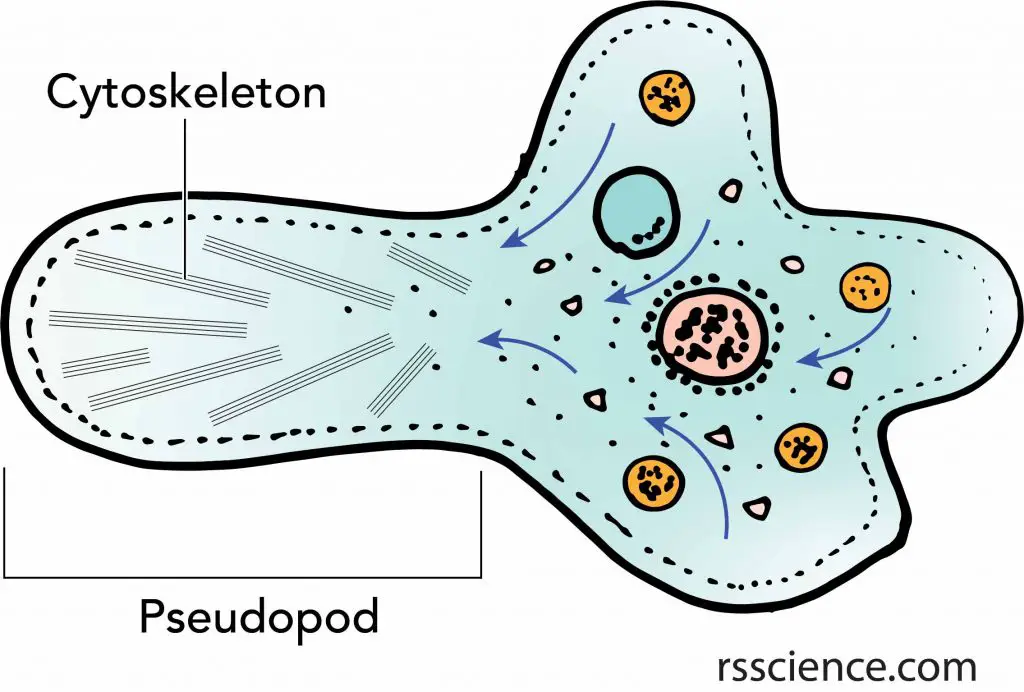
[In this figure] Amoeboid motion: an amoeba moves by stretching its pseudopods.
Under the plasma membrane of the pseudopods, there are organized cytoskeletons that generate the forcefulness to drive the change of the cell'due south shape.
In addition to using pseudopod to movement around, Amoebae also utilize them to engulf food particles.
Pseudopods are not exclusive to Amoeba. In fact, most eukaryotic cells tin change their shapes by moving their cytoskeletons. For case, the white claret cells in our immune system can patrol and prey on invaded bacteria by pseudopods.
How does Amoeba proteus swallow?
Amoeba proteus engulfs its casualty by a process called "phagocytosis". As the amoeba moves towards its prey, its pseudopods achieve out, surround, and engulf the nutrient inside the cell membrane of Amoeba proteus by forming a food vacuole. Then the digestive enzymes are released into the vacuole to break downward the food into modest food molecules for Amoeba proteus to use.
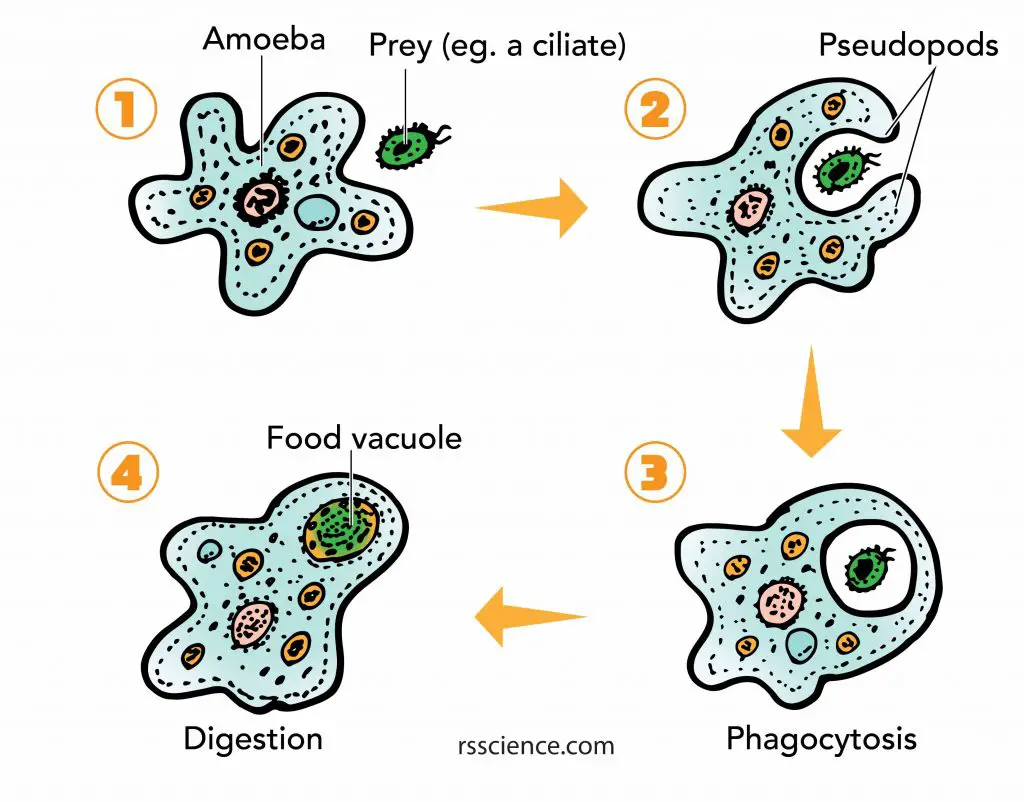
[In this figure] Amoeba phagocytosis.
The pseudopods first environs and bring the food particle close to the Amoeba. Then a part of the prison cell membrane opens to let the particle to motility into the cell and into a nutrient vacuole where it is digested by enzymes.
What is Amoeba proteus' favorite nutrient?
Amoeba proteus is a predator to bacteria, protozoa, and algae. It tin eat well-nigh any organic nutrients in its abode. Paramecium is probably the most famous casualty for Amoeba proteus. Check out the video of Amoeba hunting paramecia!
Tell me more well-nigh the secrets of Amoeba proteus!
Sure, Amoeba proteus is an astonishing fauna in several aspects.
Extremely large genome
First, Amoeba proteus is a eukaryote meaning that its genetic materials (Deoxyribonucleic acid) are enclosed in the nucleus. Scientists call the entire Dna codes in a particular organism its "genome". Judge how large the Amoeba proteus' genome is? Amoeba proteus has 290 billion base pairs (i base pair is equal to one DNA code), making it 100 times larger than the human genome (three billion)!!!
One of the largest genomes belongs to a very small creature, Amoeba dubia, a cousin of Amoeba proteus, which has 670 billion base pairs! Even so, a big genome size does not correlate with the number of genes.
Amoeba proteus has such a large genome due to an extreme replication of the aforementioned set up of genes (a archetype example of polyploidy). It tin take more than than 500 chromosomes in a single nucleus. Human beings are diploidy and we take only two copies of the same genes (or chromosomes).

[In this figure] A comparison of genome sizes of different organisms.
Early thinking held that the genome size should be directly related to the complication of organisms. However, this is non true. Some simpler organisms can have even larger genome sizes than the species at the higher levels of the evolution tree.
For instance, Amoeba proteus and Amoeba dubia accept a much bigger genome size than humans.
Notation: the genome size of Amoeba dubia (likewise called Polychaos dubium) and Amoeba proteus were measured past the 1960s methods that analyzed the whole cell rather than single nuclei. The result could be muddled by including contributions from mitochondrial Dna, possible multiple nuclei, and anything the amoeba recently engulfed.
Contractile vacuole – unique organelle
The second feature of Amoeba proteus is its build-in pumping system inside the prison cell, called "contractile vacuole". The contractile vacuole is a water chimera inside the cytoplasm of Amoeba proteus. Its function is to regulate the water content of the prison cell. Since Amoeba proteus is a unicellular organism, the h2o molecules can freely flow in or out through the semi-permeable jail cell membrane via osmosis.
When Amoeba proteus is moving to a place with fewer ions (could be minerals), the environment becomes hypotonic to the cell. This means more water molecules will move into the Amoeba proteus cell to accomplish a balance. When this happens, the contractile vacuoles tin can store extra water and help in throwing them (together with the wastes) out of the cell.
Without the contractile vacuoles, the amoeba may burst. Undoubtedly, it is a very important organelle with an essential function to the amoeba, equally well as many freshwater microorganisms.
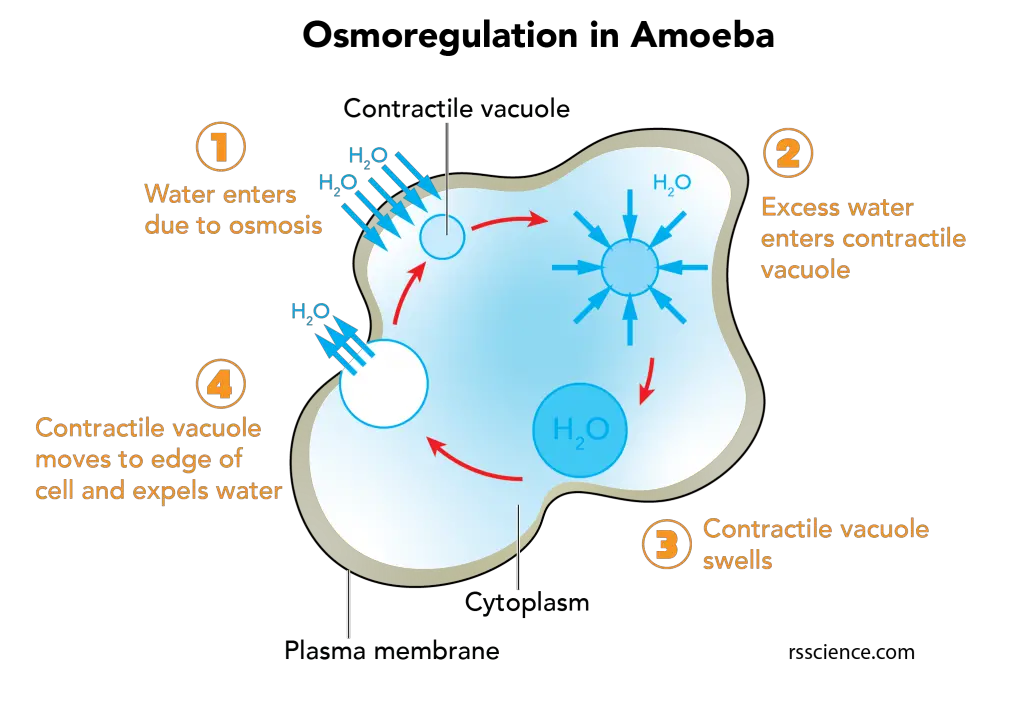
[In this figure] Osmoreulation in Amoeba.
The contractile vacuole is the key regulator of osmotic pressure in the amoeba (besides in many single-celled protists). The contractile vacuole serves as a reservoir to store excess water inside the cells. One time the water is shut to its limit, the contractile vacuole moves and fuses with plasma membrane to expel water.
Many microvilli on its cell membrane
The third hugger-mugger of Amoeba proteus is its cell membrane is not every bit polish as it shows under the optical microscope. In fact, the outside confront of the membrane has many microvilli attached to information technology (can only be seen nether an electron microscope). These microvilli can help Amoeba proteus adhere and release from the surface of the substrate.
How big is the Amoeba proteus ?
Amoeba proteus is a large protozoan, and it tin can grow up to 1 mm long (average size 250-750 µm). The size ranges based on the amount of food it engulfs. It can nigh be seen with the naked eye (nevertheless very difficult due to its colorless and transparent body).
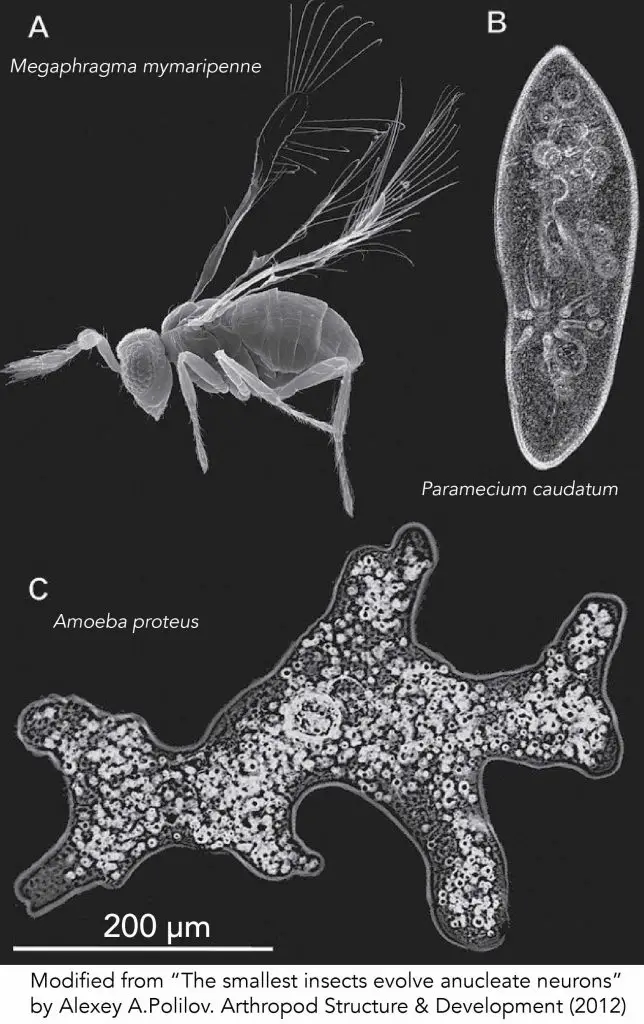
[In this figure] Size of the smallest insect and two protozoans in comparison. (A)Megaphragma mymaripenne. (B)Paramecium caudatum. (C)Amoeba proteus. Scale bar is 200 μm. Megaphragma mymaripenne, a parasitic wasp, is the smallest known flying insect.
How fast the Amoeba proteus can motion?
Amoeba proteus can move at a rate of 2-v mm per minutes.
Does Amoeba proteus have eyes?
No, Amoeba proteus doesn't have eyes (don't forget it is a single jail cell). Notwithstanding, Amoeba proteus can sense light and tends to move abroad from it. Bright light tin can fifty-fifty make all movements terminate of a sudden.
The scientists plant that Amoeba proteus tin reply to lite stimulus considering of reactions in its plasmagel, the gel-like cytoplasm at the tips of pseudopods. The light makes its plasmagel thicker and stiffer, and every bit a event, more difficult to move.
Other than light, Amoeba proteus can also sense several stimuli, similar chemicals, toughing, temperature, and even electric field!
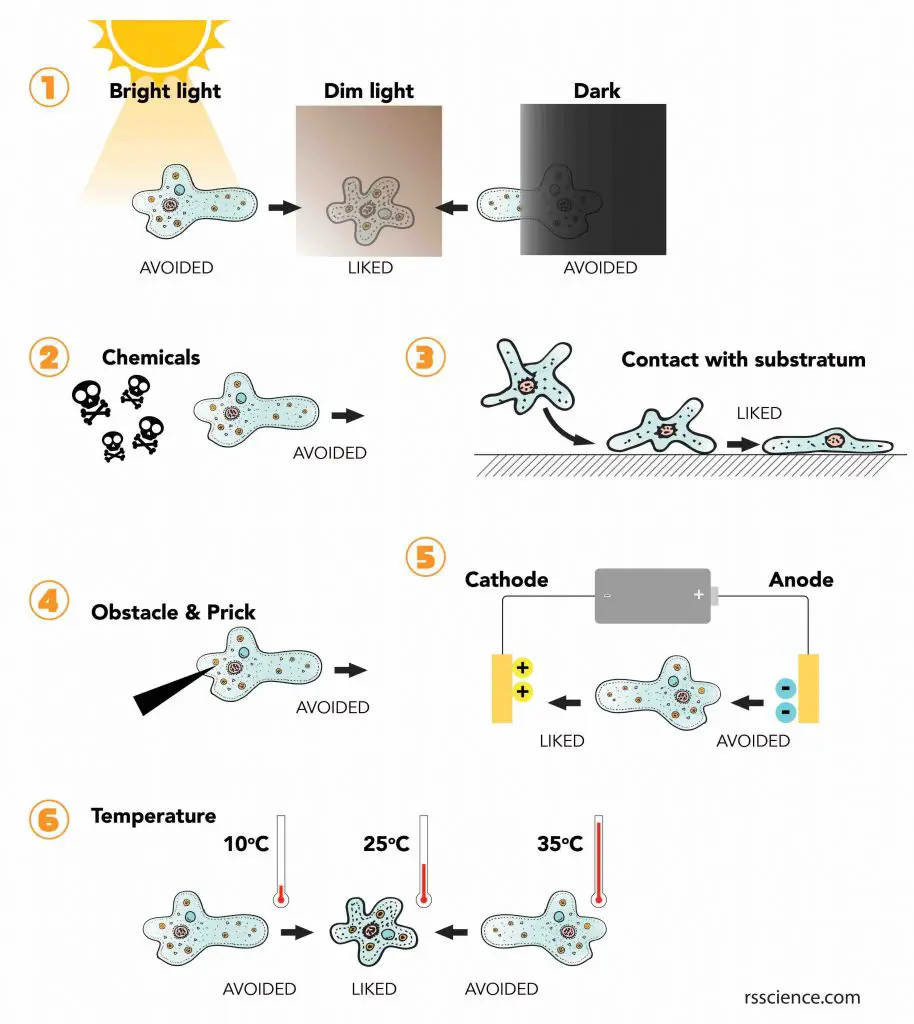
[In this figure] Fifty-fifty though the amoeba is just a single-celled organism, it can respond to various ecology changes.
(1) Amoeba will avoid bright light. It besides does not stay in the complete dark due to the lack of nutrient. Amoeba prefers in a dim light surround like under the shadow of water plants or rocks.
(2) Amoeba tin sense and avoid certain chemicals that are toxic.
(three) Amoeba does not like to bladder effectually. If possible, it will like to adhere to the surface of the substratum.
(4) Amoeba will avoid obstacles and sharped objects while it moves.
(5) When scientists place an amoeba in an electrical field, the amoeba tends to motion toward the cathode.
(6) Amoeba likes to stay at a temperature around 25oC.
How does Amoeba proteus breathe?
Because the Amoeba proteus is a single-celled organism, oxygen and carbon dioxide can freely lengthened in and out of its prison cell membrane. As well, other substances (h2o-soluble molecules like salt) are able to transport through the membrane by osmosis.
How does Amoeba proteus reproduce?
About of the time, Amoeba proteus reproduces asexually by splitting one cell into ii cells, a process chosen "Binary Fission". But earlier information technology reproduces, Amoeba proteus retracts most of its pseudopods and rounds up into a ball.
After replicating its genetic fabric (Dna) in the nucleus, the original nucleus of the Amoeba divides to form two girl nuclei by the process of Karyokinesis. In this process, the long DNA molecules condense into chromosomes (rod-liked shape) to facilitate the separation.
Afterward the nucleus has divided into two, the process of Cytokinesis takes identify in which the cytoplasm in the mother cell pinches in and divides into two girl cells. This leads to the germination of the two daughter Amoebae cell, having a nucleus and its own jail cell cytoplasm and organelles. Normally, the entire process may last anywhere from 30 minutes to an 60 minutes.
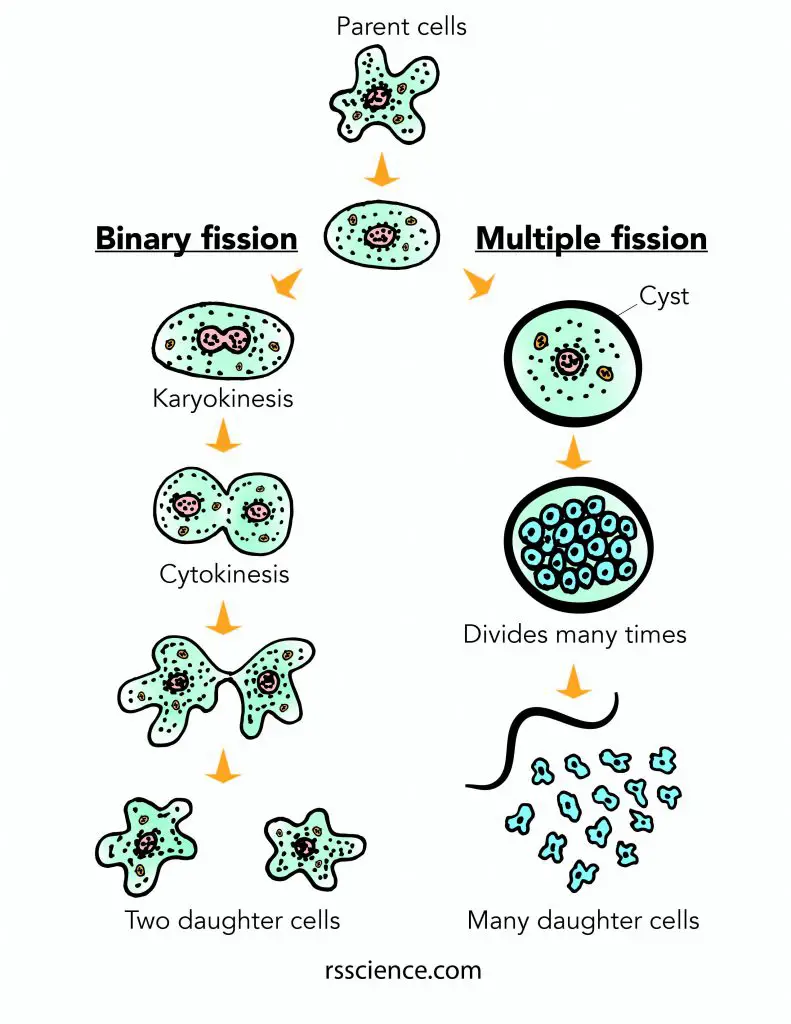
[In this figure] 2 ways of amoeba reproduction: Binary fission and Multiple fission.
Nigh of the fourth dimension, amoebas reproduce by binary fission. When the environment is turning harsh, amoebas conform to multiple fission to increase the risk to survive.
There is another rare way for Amoeba to reproduce, chosen Encystment or Multiple Fission.
When amoeba senses the environment become unfavorable (eg. lack of nutrients, too acidic or too much bright light), information technology withdraws its pseudopodia and releases a protective glaze (called a cyst) made of a chitin-similar substance to embrace its cell membrane. This cyst is able to survive in much harsher conditions. At the aforementioned time, mitosis occurs many times inside the cyst, producing more than ii daughter cells. When the cyst wall ruptures (when the condition turns favorable), these daughter cells are then released to become several new amoebas.
When the environment of habitation becomes extremely unfavorable, Amoebas volition reproduce through spores. This sexual reproduction can create genetic diverseness and increase its adventure to survive in harsh conditions.
Where to look for Amoeba proteus?
Amoeba proteus likes to stay at the bottom of clean freshwaters. It is constitute feeding on decaying substances on the bottom of freshwater streams and stagnant ponds. You lot tin use a transfer dropper to collect the bottom sediments to look for Amoeba proteus.
Amoeba proteus can likewise be ordered from scientific discipline supply companies and is the classic specimen used in the classroom to demonstrate the pseudopods in action.
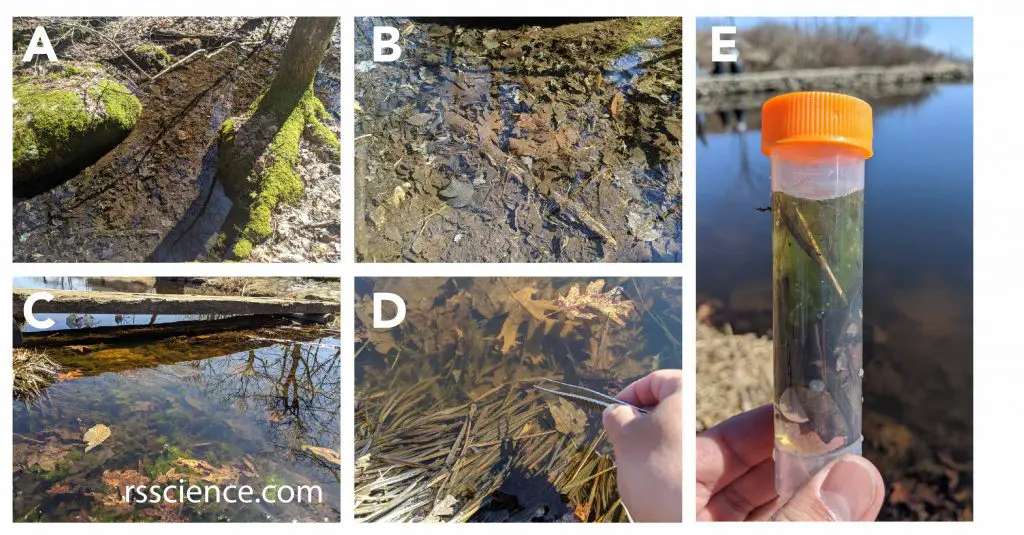
[In this figure] Where to collect the amoebas? Here are some pictures of habitations where I recently spot Amoeba proteus.
(A-C) Amoebas like to hide in the bottom sediments (like leaves) of clear h2o ponds. (D-E) I used the forceps to collect some decomposable leaves and water with sediments into my sample vial. I will bring information technology home to wait for amoebas and other pond lives nether my microscope.
How to find Amoeba proteus under an optical microscope?
Amoebas can exist directly observed under an optical microscope without additional stains. It takes patience to locate Amoebas nether the microscope because they are transparent (color-less), slow-moving, and like to encompass themselves under debris or bottom sediments.
-
Employ a transfer pipette to get a drop of water with some bottom sediments onto a microscopic slide.
-
Gently cover the sample with a coverslip and mountain it on the microscope stage for viewing. Wait five-x minutes to allow the microorganisms to adapt to the new environment (amoebas similar to attach to the surface of the glass).
-
Gradually increase the illumination (Amoebas are sensitive to brilliant lite) and scan the field by depression magnification (5x or 10x).
-
Looking for the tiny crystal-liked particles inside the cells of Amoebas may aid you locate them. If yous have stage dissimilarity or polarized low-cal filters, you may desire to utilise them.
Amoebas can as well be studied by dye staining to visualize cellular organelles. However, this requires the chemicals and equipment to fix and mount the expressionless Amoebas. If you desire to know the detail, check out this link.
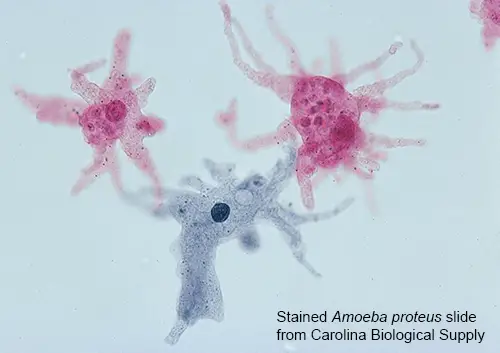
A stained Amoeba proteus slide.
What to look for under the microscope?
Directly observation of the Amoeba proteus has a significant advantage because the Amoeba proteus is still alive and agile moving when being viewed under the microscope. This allows you to see the finger-like projections (pseudopods) elongate and shorten as the Amoebas move or engulf food particles.
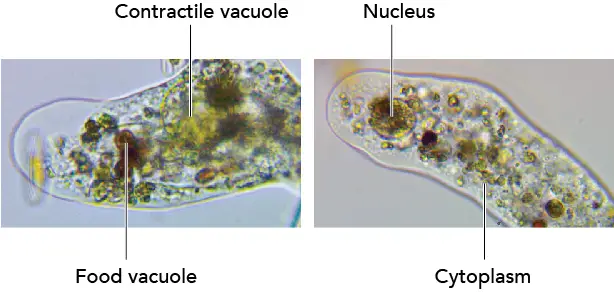
Some of the other organelles that are visible nether the microscope include:
- Nucleus: The nucleus is found near 35 µm in diameter.
- Contractile vacuole: The size of contractile vacuole may vary from 20 – 100 µm. Typically, it looks clear inside because information technology is actually a ball filled with water.
- Cytoplasm: The inner fluid containing all kinds of organelles and tiny crystals.
- Food vacuole: The food vacuoles are smaller than the nucleus. It is about 20 µm.
The color of the nutrient vacuoles inside the Amoebas can also betoken the nutrient sources in the habitation. For example, I noticed that Amoebas collected in the late bound contain more dark-green particles (could be green algae) and Amoebas from the early spring are more brownish (engrafted brown diatoms).
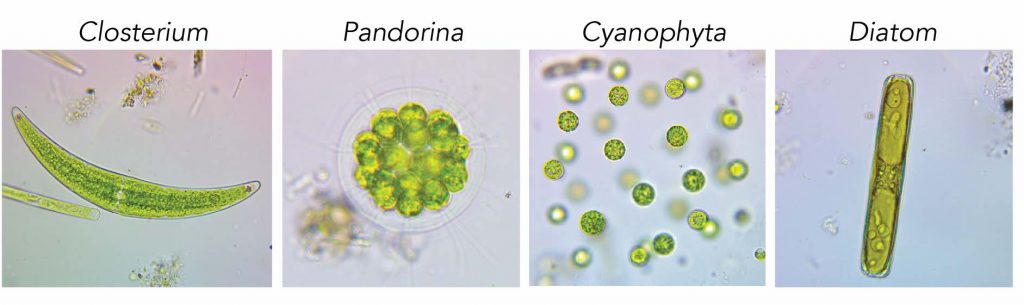
[In this figure] Examples of nutrient sources may affect the color of amoebas' nutrient vacuoles.
Sometimes, y'all may run into Amoebas in rest and stay motionless with an oval shape.
If you have a photographic camera or cell phone mounted on your microscope, the tedious-moving Amoebas are great models to practice your microphotography and video-making skills.
I saw some shiny particles inside Amoeba proteus. What is that?
Another feature that you tin can easily observe is the abundance of crystal-liked inclusions inside Amoeba proteus. Most crystals of Amoeba proteus are in a bi-pyramidal shape. These crystals are contained in vacuoles and composed of triuret, a nitrogen waste production. Other species of Amoebas have their crystals in different shapes, like spheres, sheets, and even croissant-shaped crystals.
Here are some examples of crystals in dissimilar species of Amoebas.
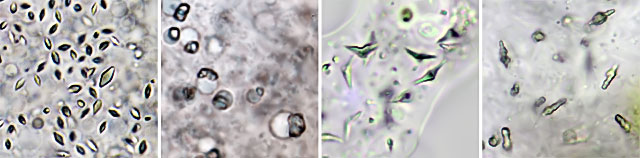
[In this figure] Crystals in different species of Amoebas.
Source: https://www.arcella.nl/inclusions/
Some large Amoebas besides take glycogen bodies to store their nutrient reserve. These glycogen bodies are glossy spheroids and vary in size. Glycogen is a class of saccharide and in our body, we shop glycogen in the liver and muscle.
When the amoeba digests big amounts of diatoms, you lot can fifty-fifty see the oil droplets inside the cell of amoeba. This is because some diatoms are tiny oil producers!
Some big amoebas contain bacteria and minor light-green algae inside their cytoplasm. These organisms have a symbiotic relationship with their host and are called "endosymbionts". For example, green algae that live within can provide boosted free energy to their host (the amoeba), making the amoeba tin live in nutrient-poor environments.
Do other Amoebas as well look similar Amoeba proteus?
The answer is no. The family of Amoebas comprises very diverse members with over 15,000 described species. Although they all share one characteristic – moving by pseudopods, they tin be totally unlike in shapes and sizes.
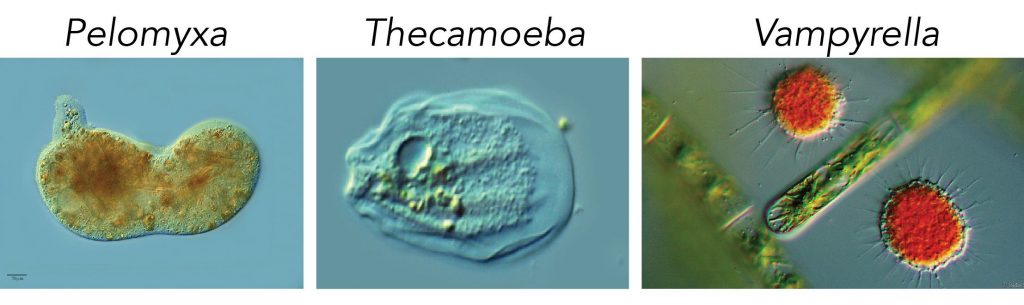
[In this effigy] Cousins of Amoeba proteus
(A) Pelomyxa is a genus of giant amoeboids, ordinarily 500-800 μm but occasionally upwardly to 5 mm in length. (B) Thecamoeba. The trunk of Thecamoeba oft forms a wrinkled cornucopia shape. (C) Vampyrella got its name by the mode it feeds. Vampyrella sticks to its victims (commonly algae), makes a big pigsty in the algal cell wall and sucks the protoplast of the algae. (Credit: Pelomyxa and Thecamoeba – eol.org ; Vampyrella – Sebastian Hess)
Amoebas can be divided into two major groups: naked amoeboids (subclass: Gymnamoebae) and shelled amoeboids (subclass: Testacea).
These Amoebas with soft, gel-similar prison cell bodies, like Amoeba proteus, Pelomyxa, Thecamoeba, and Vampyrella, are all naked amoeboids.
Surprisingly, some species of Amoebas make protective shells, called "tests", effectually their cells. Some shelled Amoebas make the tests entirely past themselves and the materials could exist organics, siliceous (containing silica) or calcareous (containing calcium carbonate) components produced past the Amoebas. These tests are called autogenic tests.
Some shelled Amoebas prepare their tests by collecting particles of sediment around them and gluing these mineral particles together by slime ingredients secreted from the cells. These tests are called xenogenic tests.
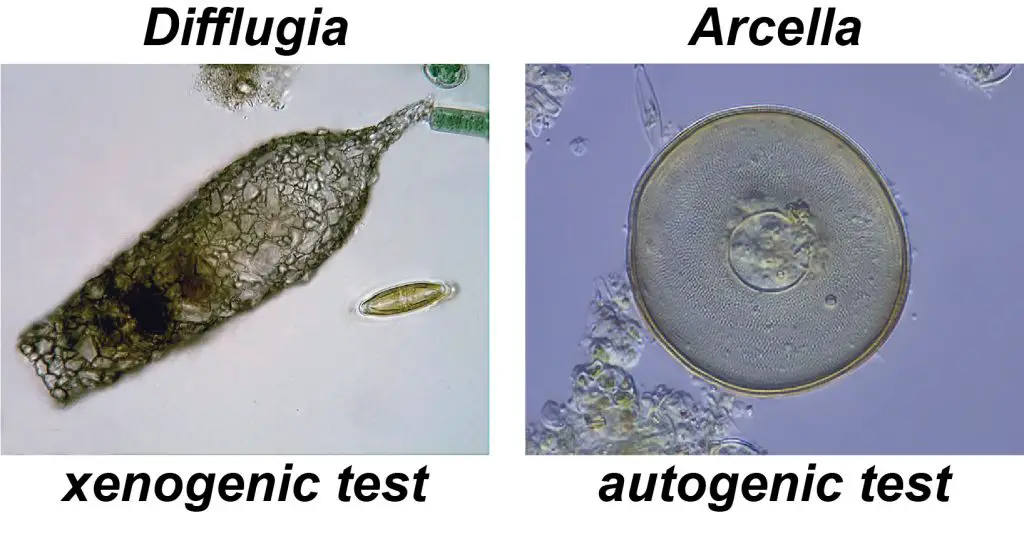
[In this effigy] Left: Vanquish of Difflugia acuminata: the xenogenic test (nearly 300 µm long) fabricated up of mineral particles glued together with secretions from within the cell. (Credit: Deuterostome on wiki); Correct: The autogenic exam (virtually 100 µm in diameter) of Arcella discoides, made up of organic plates produced by the cell. (Credit: Frank Fox on wiki)
These shelled amoebas tin can be nerveless with the same methods equally naked amoebas. However, since the tests could easily break, you have to be careful when examining them under the microscope. The weight of the coverslip may crash the tests of shelled amoebas. Use the microscopic slides with a single concave or add together some dots of Vaseline nether the corners of the coverslip to provide more than space for these creatures.
Where did the name "Amoeba" come from?
Amoeba proteus gets its name through 2 Greek words; "amoibe" meaning alter and "proteus" meaning Sea God. The Greek meaning describes this microbe as the Sea God Proteus that has a constantly irresolute shape.

[In this figure] Illustration of Proteus by Andrea Alciato from The Book of Emblems (1531)
How is Amoeba classified?
Amoebas belong to the Kingdom of the protists (a protist is any eukaryotic organism that is non an animal, plant, or fungus). Notwithstanding, in terms of nomenclature, the position of amoebas but like their shape – consistently changing.
In the early days, when microscopy was the simply way to characterize the microorganisms, amoebas were classified as Phylum Sarcodina with several other species like Heliozoa. Once molecular phylogenetics (allocate a species by its genetic materials) was introduced, amoebas are now in Phylum Amoebozoa. We have however to go on in listen that the classification of the protists is presently much debated.
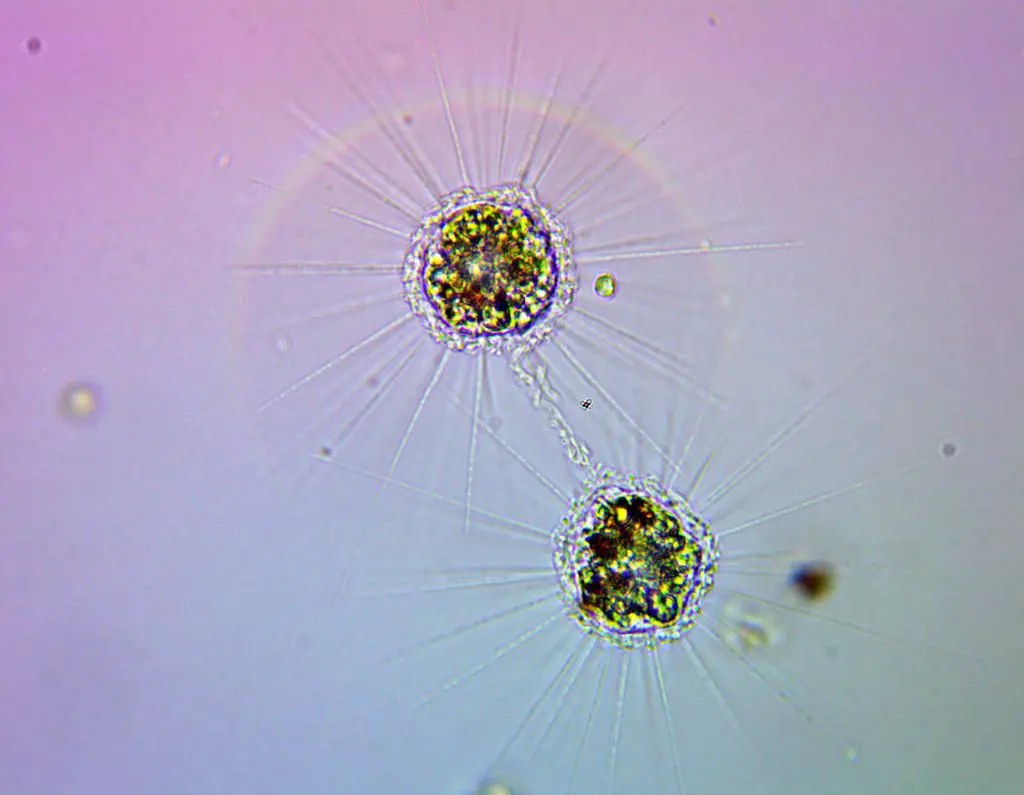
Heliozoa is commonly known as sun-animalcules. I personally similar to phone call information technology a microscopic "Uni" (bounding main urchin in Japanese)!
I heard that Amoebas can swallow homo brains. Is information technology true?
Unfortunately, it is true. Although nearly amoebas are harmless to human beings, some rare species tin can be parasitic inside the man trunk.
Naegleria fowleri, colloquially known every bit the "brain-eating amoeba", alive in freshwater ponds or streams in hot geographic areas. Naegleria fowleri has two flagella (like tails) so it can swim in the water. Most of the time, Naegleria fowleri is free-living and eats leaner. In some very rare cases, Naegleria fowleri can be inhaled through the olfactory organ and travels to the brain, causing a deadly affliction called Naegleriasis.
Really, a case of brain-eating amoeba has been confirmed in the Tampa area, according to the Florida Department of Wellness on July 6, 2020. Related news please visit hither.
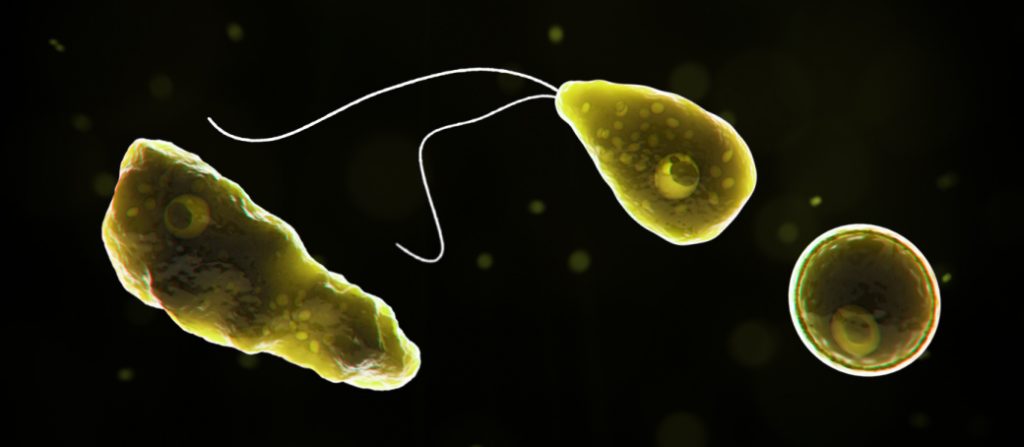
[In this effigy] Naegleria fowleri (usually referred to as the "brain-eating amoeba") is a complimentary-living microscopic amoeba. At a sure stage of its life circle, the Naegleria fowleri can swim by ii flagella. (Source: CDC – https://world wide web.cdc.gov/parasites/naegleria/)
Did you lot know?
Amoeba Proteus, Euglena, Tardigrade, and Paramecium caudatum are the most frequently studied microlife creatures in classrooms and laboratories.
References
Source: https://rsscience.com/facts-about-amoeba/
Posted by: hoserearget1982.blogspot.com
0 Response to "What Is The Makeup Of Amoeba"
Post a Comment